Executive Summary
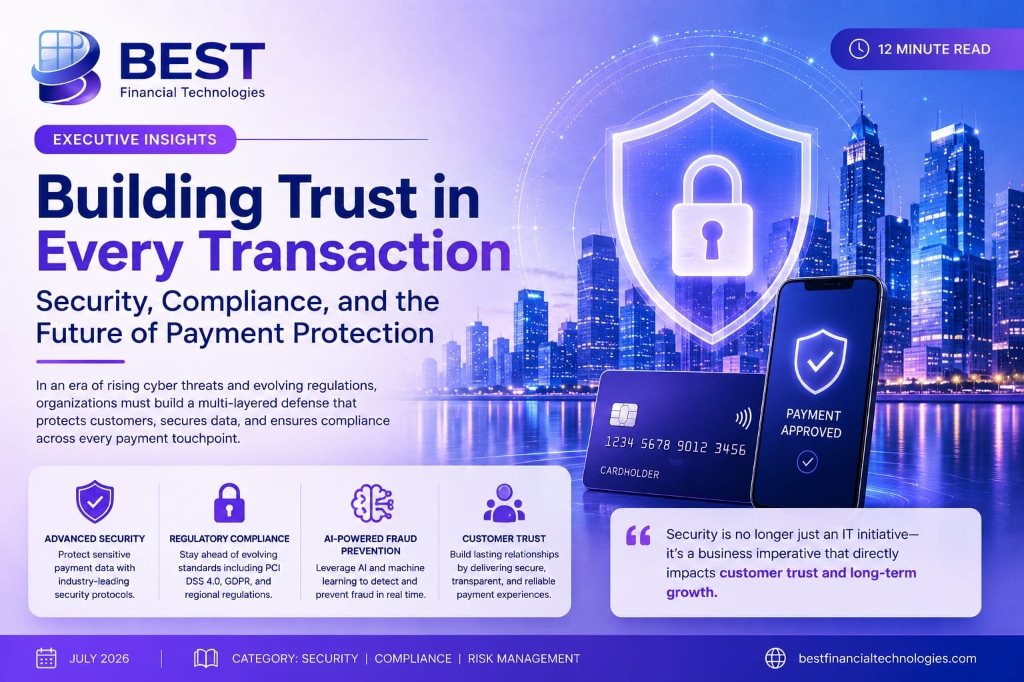
Trust is the foundation of every successful payment ecosystem. In an era of growing cyber threats, evolving regulations, and increasing customer expectations, organizations must view security and compliance as strategic business priorities. Protecting payment data is no longer simply an IT responsibility—it is essential for customer confidence, operational resilience, and sustainable growth.
The Modern Fraud Landscape
Cybercriminals continuously adapt their techniques, targeting payment systems through phishing, account takeover, identity theft, ransomware, social engineering, and payment fraud. As digital commerce grows, organizations must adopt proactive security strategies that identify risks before they affect customers or business operations.
Security in 2026: A Multi-Layered Approach
Modern payment security combines encryption, tokenization, multi-factor authentication, network segmentation, endpoint protection, continuous monitoring, and behavioral analytics. Layered security reduces the likelihood that a single vulnerability can compromise sensitive payment information.
PCI DSS 4.0 and Regulatory Compliance
Compliance with standards such as PCI DSS provides organizations with structured controls for protecting payment card information. Depending on industry and geography, businesses may also need to consider privacy regulations and financial compliance requirements. Compliance should be viewed as a continuous process rather than an annual checklist.
Artificial Intelligence in Fraud Prevention
AI-powered fraud detection analyzes transaction behavior in real time to identify unusual patterns while reducing false positives. Machine learning continuously improves detection accuracy by learning from historical activity, helping organizations respond faster to emerging threats.
Building Customer Trust
Customers expect their financial information to remain secure. Transparent privacy practices, secure authentication, rapid incident response, and consistent communication all contribute to long-term trust. Organizations that invest in security often strengthen both their reputation and customer loyalty.
Creating a Security-First Culture
Technology alone cannot eliminate cyber risk. Employee awareness, executive leadership, governance, vendor management, regular security assessments, and incident response planning are equally important. Building a culture of security helps reduce human error and supports organizational resilience.
Executive Checklist
Core Takeaways & Recommendations
- Review payment security policies regularly.
- Validate compliance requirements.
- Implement multi-factor authentication.
- Monitor transactions continuously.
- Perform penetration testing and risk assessments.
- Train employees on phishing and cyber awareness.
- Develop and test incident response plans.
Key Takeaways
Core Takeaways & Recommendations
- Security is a business enabler, not merely a technical requirement.
- Organizations that combine strong cybersecurity, regulatory compliance, AI-driven fraud prevention, and customer-focused security practices are better positioned to protect their reputation, support sustainable growth, and build lasting trust.
About BEST Financial Technologies
BEST Financial Technologies delivers secure, scalable payment solutions that help organizations strengthen compliance, improve operational resilience, and protect customer trust through modern payment technologies.
Need the Full Official Executive PDF?
Download the complete whitepaper format of this Executive Insight for offline reading and leadership sharing.
Download Official PDF ReportExplore BEST Solutions
Instant Issue Card Programs
Launch customizable virtual and physical card programs with API-configured daily limits and category controls.
Same-Day Payout Gateway
Route treasury and merchant payouts to bank accounts on the same day with direct ACH and push-to-card pipelines.